Campus News
By Priscilla Mafa
Midlands State University’s Zvishavane Campus is set to host a public lecture by the Tugwi-Mukosi Multidisciplinary Research Institute (TMMRI) on Thursday, 20 August 2026, as the university continues to expand opportunities for research dissemination and public engagement.
The lecture is scheduled to take place from 10am to 12 noon at the New Boardroom at Zvishavane Campus.
The engagement forms part of MSU’s efforts to bring research closer to students, academics and the wider university community by creating platforms through which research findings, ideas and areas of innovation can be shared and discussed.
TMMRI is among the research-focused structures associated with MSU’s Zvishavane Campus. The university has, for example, advertised research positions under the institute in areas including aquaculture and fisheries, highlighting its multidisciplinary focus and interest in research addressing environmental and natural-resource issues.
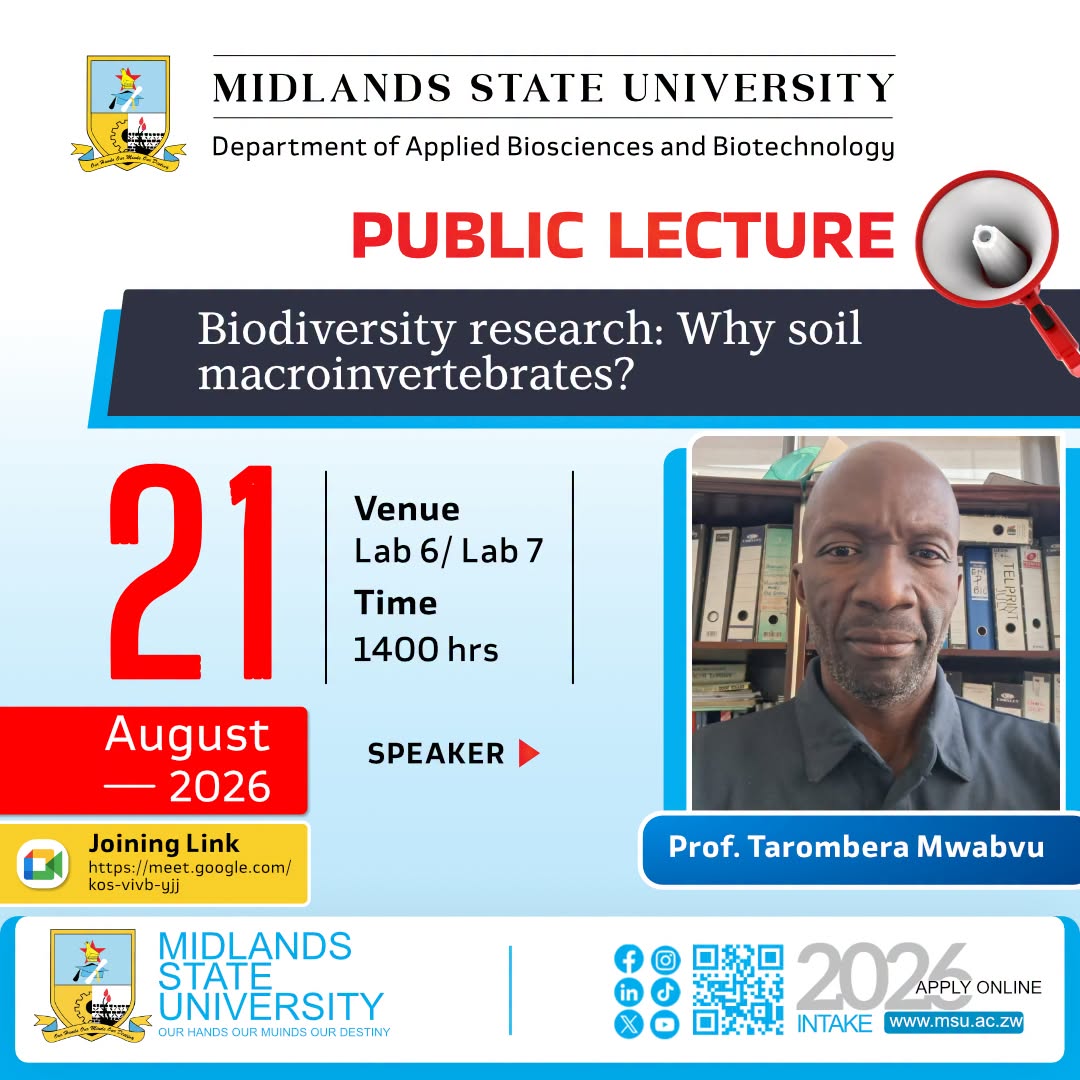
The public lecture will be followed on Friday, 21 August, by another research-focused engagement organised by MSU’s Department of Applied Biosciences and Biotechnology.
The second lecture will be held under the theme:
“Biodiversity Research: Why Soil Macroinvertebrates?”
The lecture is scheduled for 2pm at Lab 6/Lab 7 and will be presented by Professor Tarombera Mwabvu.
Professor Mwabvu is a biologist and taxonomist whose research focuses extensively on soil macroinvertebrates, including their taxonomy, distribution and responses to changes in habitat. The University of Mpumalanga, where he is a professor in the School of Biology and Environmental Sciences, describes his research interests as including the taxonomy, faunistics and phylogenetics of flightless soil macroinvertebrates and their response to habitat transformation.
is work provides a strong scientific foundation for a discussion on why organisms living within and on the soil surface matter to biodiversity and ecosystem health.
Professor Mwabvu has previously delivered a professorial lecture titled “Life on Land: Why Soil Macroinvertebrates?” at the University of Mpumalanga. The lecture examined the role of soil organisms in maintaining healthy ecosystems and safeguarding biodiversity.
In discussing the significance of soil macroinvertebrates, Professor Mwabvu has highlighted their importance to ecological processes, including nutrient cycling and soil health. He has also emphasised the importance of understanding their diversity and distribution for conservation and sustainable agriculture.
The subject is particularly relevant to Zimbabwe and the wider region, where soils support agriculture, biodiversity and numerous ecosystem processes.
Soil macroinvertebrates include organisms such as earthworms, millipedes and other larger soil-dwelling invertebrates. Although many of these organisms remain largely unseen, they contribute to processes that influence soil structure, nutrient cycling and ecosystem functioning.
The two public lectures provide MSU students and researchers with an opportunity to engage with multidisciplinary research while also demonstrating the university's role in making scientific knowledge accessible beyond specialised academic publications.
For students, the sessions can also provide an opportunity to interact with researchers and gain a better understanding of how scientific research is conducted, communicated and applied to real-world environmental challenges.
The back-to-back engagements are expected to strengthen the research culture at the Zvishavane Campus and encourage greater interaction between researchers, students and the wider university community.
The lecture is scheduled to take place from 10am to 12 noon at the New Boardroom at Zvishavane Campus.
The engagement forms part of MSU’s efforts to bring research closer to students, academics and the wider university community by creating platforms through which research findings, ideas and areas of innovation can be shared and discussed.
TMMRI is among the research-focused structures associated with MSU’s Zvishavane Campus. The university has, for example, advertised research positions under the institute in areas including aquaculture and fisheries, highlighting its multidisciplinary focus and interest in research addressing environmental and natural-resource issues.
The public lecture will be followed on Friday, 21 August, by another research-focused engagement organised by MSU’s Department of Applied Biosciences and Biotechnology.
The second lecture will be held under the theme:
“Biodiversity Research: Why Soil Macroinvertebrates?”
The lecture is scheduled for 2pm at Lab 6/Lab 7 and will be presented by Professor Tarombera Mwabvu.
Professor Mwabvu is a biologist and taxonomist whose research focuses extensively on soil macroinvertebrates, including their taxonomy, distribution and responses to changes in habitat. The University of Mpumalanga, where he is a professor in the School of Biology and Environmental Sciences, describes his research interests as including the taxonomy, faunistics and phylogenetics of flightless soil macroinvertebrates and their response to habitat transformation.
is work provides a strong scientific foundation for a discussion on why organisms living within and on the soil surface matter to biodiversity and ecosystem health.
Professor Mwabvu has previously delivered a professorial lecture titled “Life on Land: Why Soil Macroinvertebrates?” at the University of Mpumalanga. The lecture examined the role of soil organisms in maintaining healthy ecosystems and safeguarding biodiversity.
In discussing the significance of soil macroinvertebrates, Professor Mwabvu has highlighted their importance to ecological processes, including nutrient cycling and soil health. He has also emphasised the importance of understanding their diversity and distribution for conservation and sustainable agriculture.
The subject is particularly relevant to Zimbabwe and the wider region, where soils support agriculture, biodiversity and numerous ecosystem processes.
Soil macroinvertebrates include organisms such as earthworms, millipedes and other larger soil-dwelling invertebrates. Although many of these organisms remain largely unseen, they contribute to processes that influence soil structure, nutrient cycling and ecosystem functioning.
The two public lectures provide MSU students and researchers with an opportunity to engage with multidisciplinary research while also demonstrating the university's role in making scientific knowledge accessible beyond specialised academic publications.
For students, the sessions can also provide an opportunity to interact with researchers and gain a better understanding of how scientific research is conducted, communicated and applied to real-world environmental challenges.
The back-to-back engagements are expected to strengthen the research culture at the Zvishavane Campus and encourage greater interaction between researchers, students and the wider university community.
Published
August 18, 2026 at 9:00 AM